We use cookies on this site to enhance your experience.
By selecting “Accept” and continuing to use this website, you consent to the use of cookies.
March 11, 2026
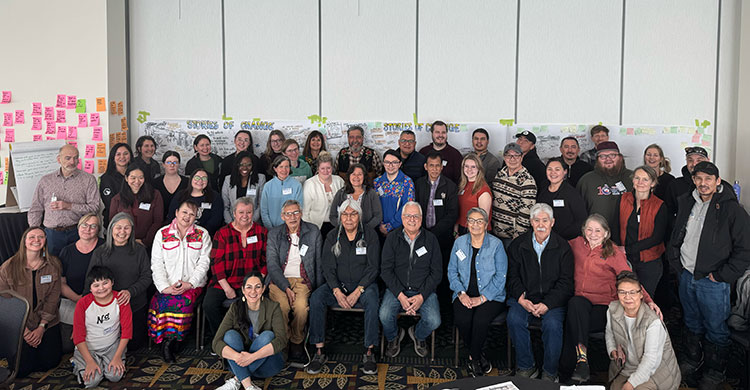
Print | PDFThe CRRC has strengthened its external partnerships and secured non-tri-agency support to facilitate collaboration and knowledge exchange. The CRRC, in close collaboration with the Research Office at Laurier, partnered with the Mackenzie River Basin Board (MRBB) to co-organize the Stories of Change: Mackenzie River Basin Climate Change Workshop. This workshop was held in Yellowknife, Northwest Territories, from March 4-5, 2026, and brought together Indigenous communities, researchers, and government partners. CRRC secured $89,405 in funding over one year from the Canada Water Agency (CWA) to help plan and coordinate the delivery of this workshop.
Laurier researchers and CRRC members played a major role throughout the event. Dr. Homa Kheyrollah Pour delivered welcoming remarks on behalf of CRRC and co-presented on Ice and Snow Dynamics Across the Great Bear and Great Slave Lake Basin alongside Walter Bezha from the Délı̨nę Got'ı̨nę Government. Dr. Jennifer Baltzer presented on the impacts of wildfires on freshwater ecosystem health, while Dr. Gifty Attiah presented research on water temperature and turbidity changes across Great Bear and Great Slave Lakes. Dr. Heidi Swanson and William Agler participated in the panel discussion, Bridging Traditional Knowledge Systems with Science to Assess Ecosystem Health, and presented on community-based aquatic ecosystem monitoring.
The workshop agenda included keynote presentations, panel discussions, storytelling sessions, and collaborative discussion blocks on various topics, including community-based monitoring. Participants also explored how Traditional Knowledge and Western Science can work together to better understand and respond to rapid environmental change in the North. These findings will contribute to the next web-based Mackenzie River Basin State of the Aquatic Ecosystem Report (SOAER) to support future collaborations among communities, researchers, and decision-makers across the basin.
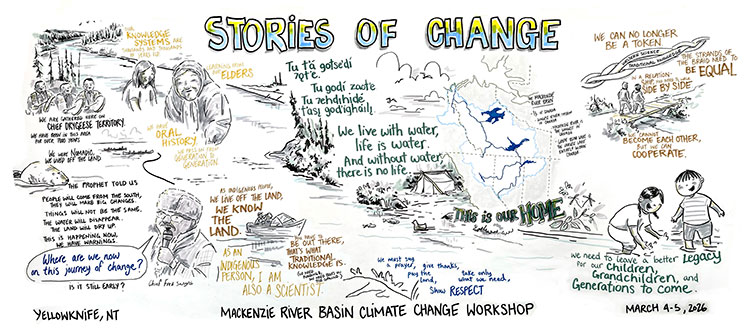
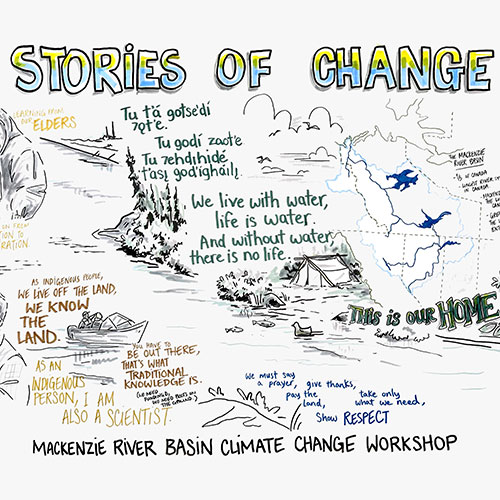
Throughout the workshop, Alison McCreesh, a visual artist, transformed the conversations into a large-scale visual drawing. Alison carefully captured key themes, insights, and connections in real-time, creating a piece that reflects the depth and energy of the dialogue. The final drawing not only showcased everything that was discussed but also served as a creative and engaging way to see the attendees’ collective thoughts woven together into a story.