
We use cookies on this site to enhance your experience.
By selecting “Accept” and continuing to use this website, you consent to the use of cookies.
Applicants are asked to share reflections on the challenges and rewards of northern research.
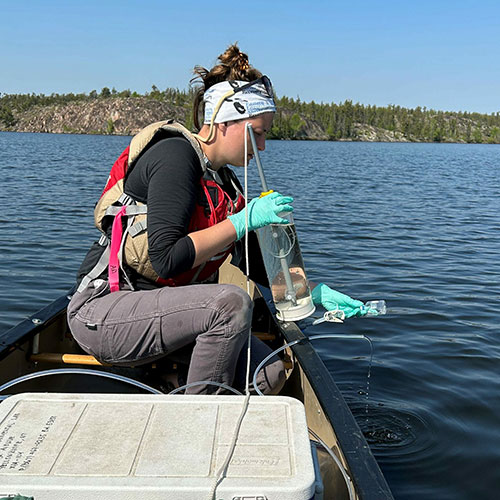
Daniela Klicper is a PhD Candidate in Geography at Wilfrid Laurier University, and lives in the small town of Goderich, Ontario. Her research takes her across great distances to study subarctic limnology, with countless hours spent sampling lakes around Yellowknife in open water and under ice conditions. Her doctoral research focuses on identifying the key drivers of cyanobacterial bloom formation in Jackfish Lake, Northwest Territories, to inform bloom management.
"Conducting research in Canada’s North is both challenging and deeply rewarding. Every field season carries high stakes—equipment must function, weather is unpredictable, and setbacks are inevitable. Working in remote environments fosters humility and requires comfort with uncertainty; with limited resources and support, you learn by doing, adjusting, and troubleshooting in real time.
"Despite the challenges, the rewards far outweigh them. There’s a unique bond that forms when you’re united with colleagues by a shared passion—in my case, understanding water quality risks in subarctic lakes amid a changing climate. As a student from southern Canada, this work has deepened my appreciation for the North’s landscapes, ecosystems, and communities. Studying these environments is one thing—experiencing them firsthand is another. Moments like hauling equipment across a frozen lake or building a makeshift catamaran from two canoes and 2x4s stay with you. Northern research goes beyond data collection; it broadens our understanding of Canada’s vast geographic, cultural, and ecological diversity. Despite its size, the North is often overlooked by those in the South. Spending time there challenges assumptions and brings awareness to the region’s unique realities—from climate change and infrastructure gaps to the resilience of Northern and Indigenous communities."
Daniela Klicper
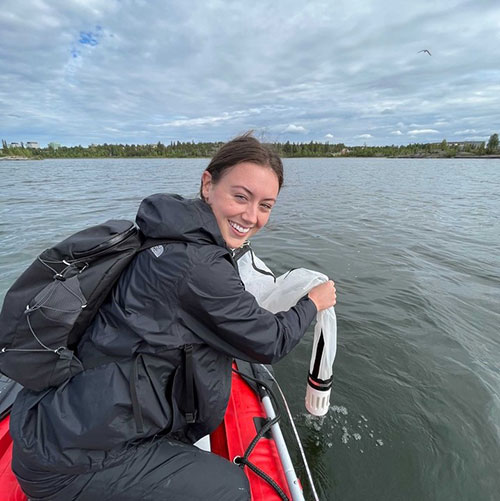
Madeline Patenall was the 2024 winner. Madeline has spent significant time in the North, developing a deep appreciation for its unique ecosystems and landscapes. She is a first-year Ph.D. Student in Biological and Chemical Sciences at Laurier. Her research investigates the impact of municipal and industrial activities on the biology and chemistry of sub-arctic lakes in the Northwest Territories
"My time in northern research has presented numerous challenges, from battling mosquitoes and enduring harsh weather conditions to losing equipment at the bottom of lakes. However, the challenges have been learning experiences; long days in the field have taught me resilience, uncontrollable delays have fostered patience, and logistical and funding challenges have improved my problem-solving. Most significantly, I am continually challenged to educate myself on how to conduct more collaborative and respectful research.
"Yet, for all the challenges I encounter, the rewards stick with me the most. I cherish the beauty and humanity I have experienced; I’ve been in awe of the landscapes in the Taiga, seen knowledge passed down to the next generation, felt camaraderie after a trying field day, been helped by strangers, learned the importance of being on the land, witnessed people come together to support one another and experienced the joys of collaboration.
"My time and experiences in northern research have been a privilege. The challenges have shaped me, while the rewards have gifted me deeply cherished memories."
Madeline Patenall
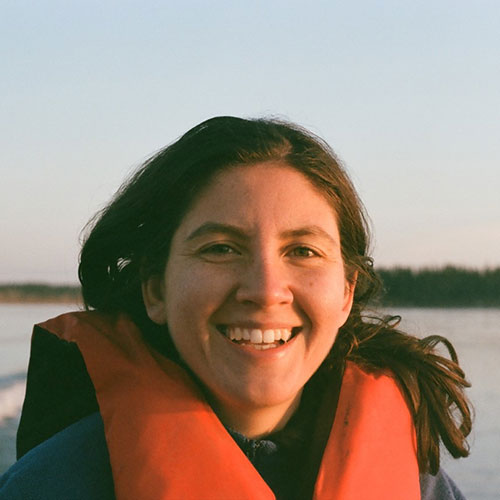
The 2023 winner was Elise Brown-Dussault. Elise is a Yukon resident who loves the boreal forest, sandhill cranes, spruce tips, black bears, and bog cranberries. She is a first-year Master’s Student in Integrative Biology at Laurier. Her research is about caribou habitat restoration and takes place in the Southern Great Slave Region of the Northwest Territories.
"I have been a northern resident since 2017 and conducting field work in the north since 2019. The unique frustration and gratification that northern field work brings are familiar!
"To me, a big part of what makes northern field work challenging is its high access barriers. Requisite post-secondary schooling, lower pay, short contracts, and the requirement for expensive outdoor equipment pose a socio-economic barrier to many northern residents who deserve the opportunity to care for their homelands professionally. I have many northern colleagues that cannot partake in field work because it would not allow them to hold a second job or care for their family.
"The rewarding aspects of northern fieldwork are obvious. Being welcomed at community events this past year, such as a fish fry and an on-the-land camp, have given me memories I cherish. I will also never tire of northern skies; the beauty, spectacle, and sheer commotion northern birds always bring (looking at you, sandhill cranes); and berry stains on your face and field clothes at the end of a day well spent. I never take my luck to work in conservation and on the land for granted."
Elise Brown-Dussault